Planet Group International (PGI) is extending its CentroAI Case IDP platform — already deployed across banking, finance, healthcare, and government workflows — into engineering and EPC (Engineering, Procurement & Construction) document processes. The first use cases target one of the industry’s most document-heavy protocols: transmittal management, covering both incoming and outgoing packages.
Why now: engineering is catching up on AI — carefully
Engineering and construction have historically been conservative in adopting new digital technologies. That is changing: according to Deloitte Australia’s State of Digital Adoption in the Construction Industry 2026 report, based on a survey of 954 construction and engineering businesses across Australia, Hong Kong, India, Japan, Singapore, and Vietnam, AI and machine-learning tool usage has grown to 46% of businesses, up from roughly a quarter in the first edition of the same report in 2023.
Deloitte’s 2026 Engineering and Construction Industry Outlook points to a similar shift globally: firms are increasingly piloting agentic AI systems to help manage scheduling, coordinate workflows, and mitigate risk, and digital workflows such as BIM, 3D printing, and digital twins are reported to shorten project timelines by up to 20% by enabling more accurate planning and minimizing rework. The same outlook links part of this push to the industry’s persistent labor shortage — Deloitte projects a need for roughly 499,000 new workers in 2026, up from 439,000 in 2025 — and notes that firms are expected to accelerate investment in digital tools and automation as one way to offset that gap.
The same Deloitte report adds an important caveat, one that shapes how PGI is approaching this expansion: poor-quality data continues to undermine the reliability of analytics and AI tools, limiting the return firms actually see on their investment. Adoption alone isn’t the story — governance and data quality are what determine whether AI delivers real value on document-heavy engineering work. That is the gap CentroAI Case IDP is built to address: not by automating decisions away from engineers, but by structuring and pre-checking information before it reaches them.
The challenge: a transmittal is a small project of its own
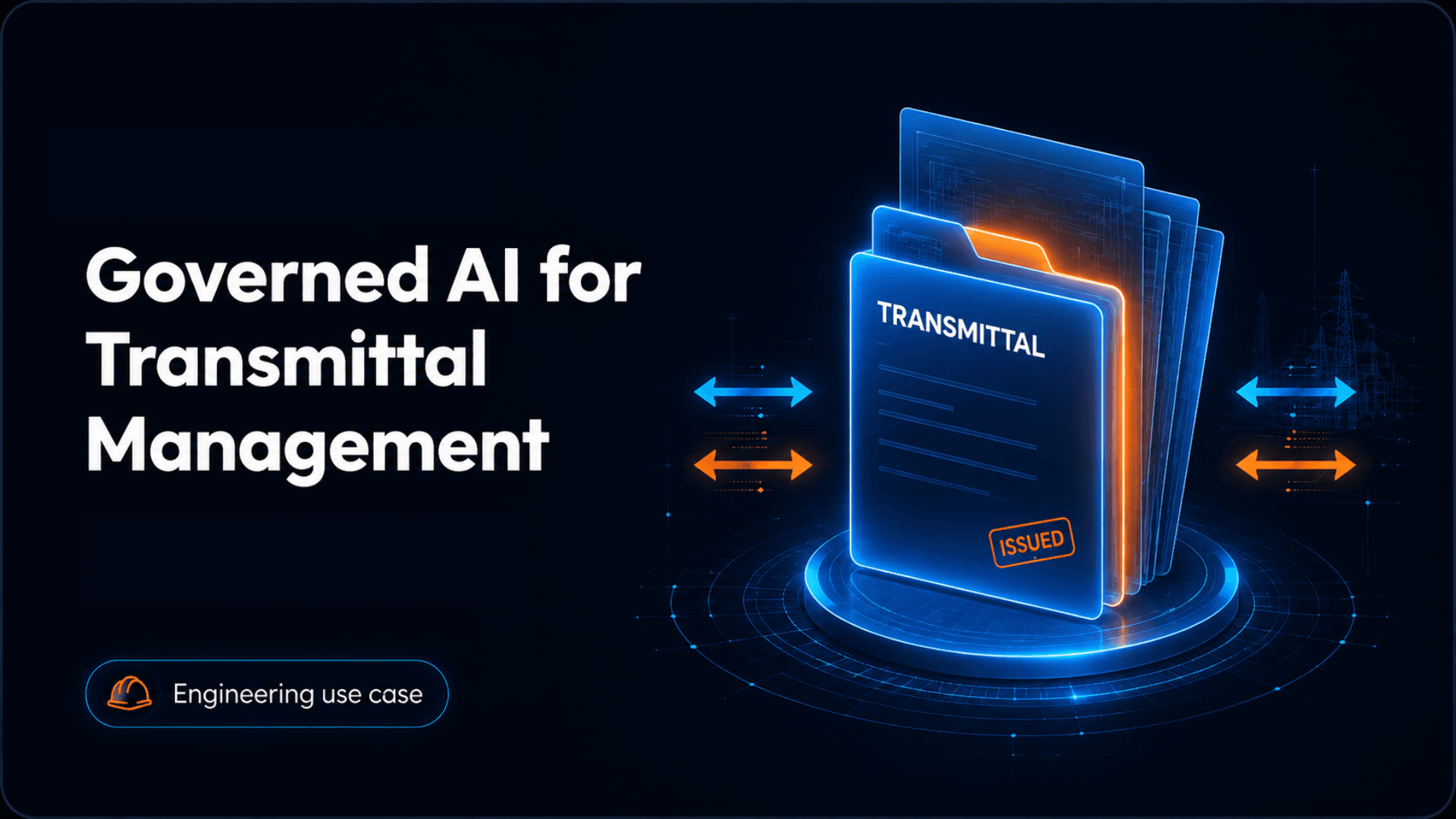
In a large engineering project — designing a pumping station inside a larger industrial facility, for example — every technical topic becomes its own document package: a transmittal. It has a cover page listing what’s inside, an author, a date, and a stack of technical documents behind it — drawings, specifications, calculations.
Before a transmittal ever leaves a project team, it’s usually assembled and reviewed by several people internally, grouped, checked, and approved before it’s considered ready to send. Once it reaches the other side — the EPC contractor or the client, a private investor or a public institution — the exchange runs in both directions: the recipient reviews the package, may return it with comments or annotations, and eventually sends back an approval, sometimes with an additional record attached, such as a sign-off report. It’s a formal, auditable protocol, and for good reason: without disciplined version and content tracking, teams risk working from an outdated technical document — on an engineering project, that can mean costly delays or on-site mistakes.
The practical difficulty is volume. A single transmittal can bundle dozens of documents. Checking one properly means matching the cover page count against the actual contents, verifying document names, and cross-checking technical figures — like total areas shown on drawings — against what the contract states. That work currently falls on engineers, document controllers, and project managers, from scratch, every time a package changes hands.
What’s new: Transmittal Case Incoming & Outgoing
CentroAI Case IDP now includes two engineering-specific use cases built directly around this protocol:
Transmittal Case Incoming pre-checks an incoming package before a human reviewer starts: does the number of documents match the cover page, do document names line up between the cover page and the contents, are technical figures — like the total area shown on drawings — consistent with what’s in the contract. The reviewer receives a short summary of findings, such as a missing editable drawing file, as a starting point for their review, not a final decision.
Transmittal Case Outgoing applies the same discipline in the other direction: before a package goes out to a client or a regulatory body, it’s checked for completeness, formatting, and required elements — including something as simple but critical as the correct signature being present.
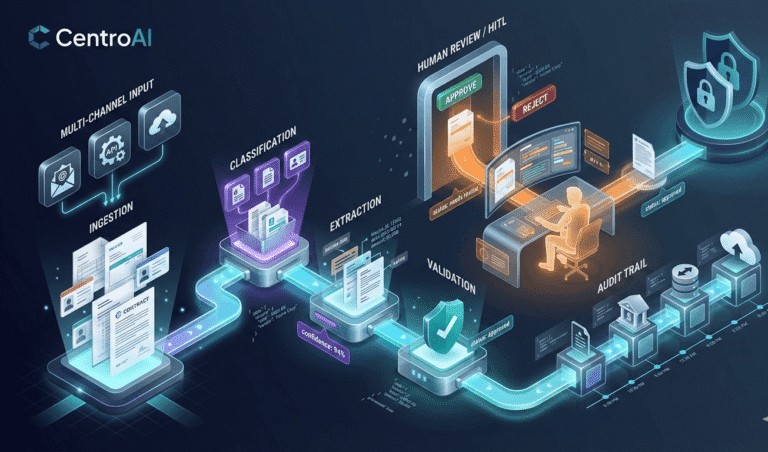
Both cases keep a human reviewer firmly in the loop. CentroAI surfaces what’s consistent and what needs a second look; people still make the final call. It’s the same “prepare → verify → approve” workflow engineering teams already follow — just with the repetitive first pass handled faster, so reviewers can spend their time on the technical judgment calls that actually need their expertise, rather than counting documents and cross-checking names.
These two cases sit alongside other engineering workflows already mapped on the CentroAI platform — including submittals and approvals, and change order/variation validation — as part of the same document-governance approach applied to engineering’s most repetitive review work.
Built on the same governance foundation
The engineering use cases inherit the governance model already running in PGI’s banking, finance, and public-sector deployments: mandatory human review on exceptions, a tamper-evident audit trail for every decision, and operation under PGI’s ISO 27001 and ISO 9001 certified management systems, with GDPR-ready controls. For engineering teams working with public institutions or regulated infrastructure projects, that audit trail — a clear record of who reviewed what, when, and why — is frequently a contractual requirement, not just good practice.
Getting started
PGI’s typical path to production runs 10–16 weeks: discovery and controls setup, a pilot build on the first workflow, and a controlled go-live, after which additional case types can typically be added in about a week.
Ready to pilot transmittal management?
Engineering and EPC teams looking to reduce review time and improve consistency on incoming and outgoing transmittals can talk to PGI’s team about scope, timeline, and expected outcomes for their own document volumes. Contact PGI
Curious what else CentroAI can do?
Transmittals are the first engineering use case — not the only one. Explore the full set of CentroAI Case IDP use cases, across engineering, banking, finance, healthcare, and government, on PGI’s use cases page. See all use cases